When I wrote about artistic expression and generative tools in Art Was Never the Instrument, I was interested in the distance between having something to express and possessing the technical means to express it. I still am, but there is a practical side to that argument that deserves its own examination. With the two soundtrack volumes accompanying my novel SIGNAL INTER/UPT, the question was no longer whether I could make music with a generative system. It was whether I could direct the system with enough precision to produce the music I actually wanted to hear.
That meant more than writing a description and choosing an attractive result. A track could be beautifully produced, tonally appropriate, and entirely wrong for its intended purpose. The wrong bass movement, a percussion pattern that landed a little too softly, a melodic phrase that resolved too early, or a transition that arrived before it had earned its place could change the character of the piece. Those were not incidental imperfections to be overlooked because the output sounded professional. They were reasons to reject it.
The process eventually became remarkably controlled, although not perfectly deterministic. Suno would sometimes ignore the requested total duration, and its interpretation of musical instructions was not as exact as a sequencer executing a MIDI file. But it followed enough of the intended musical structure, often closely enough across two separate generations, that the remaining work became less about discovering a song and more about selecting and refining its performance.
Two Albums, Two Musical Environments
SIGNAL INTER/UPT inhabits a technologically saturated world, and the soundtrack needed to be part of that world rather than decorative music placed alongside it. The first volume draws from the scale, seduction, engineered pleasure, and unease of Aura-Veritas. The second turns toward the Basement, a more enclosed setting where atmosphere depends on proximity, repetition, uncertainty, and the feeling that a space has begun to exert an influence of its own.
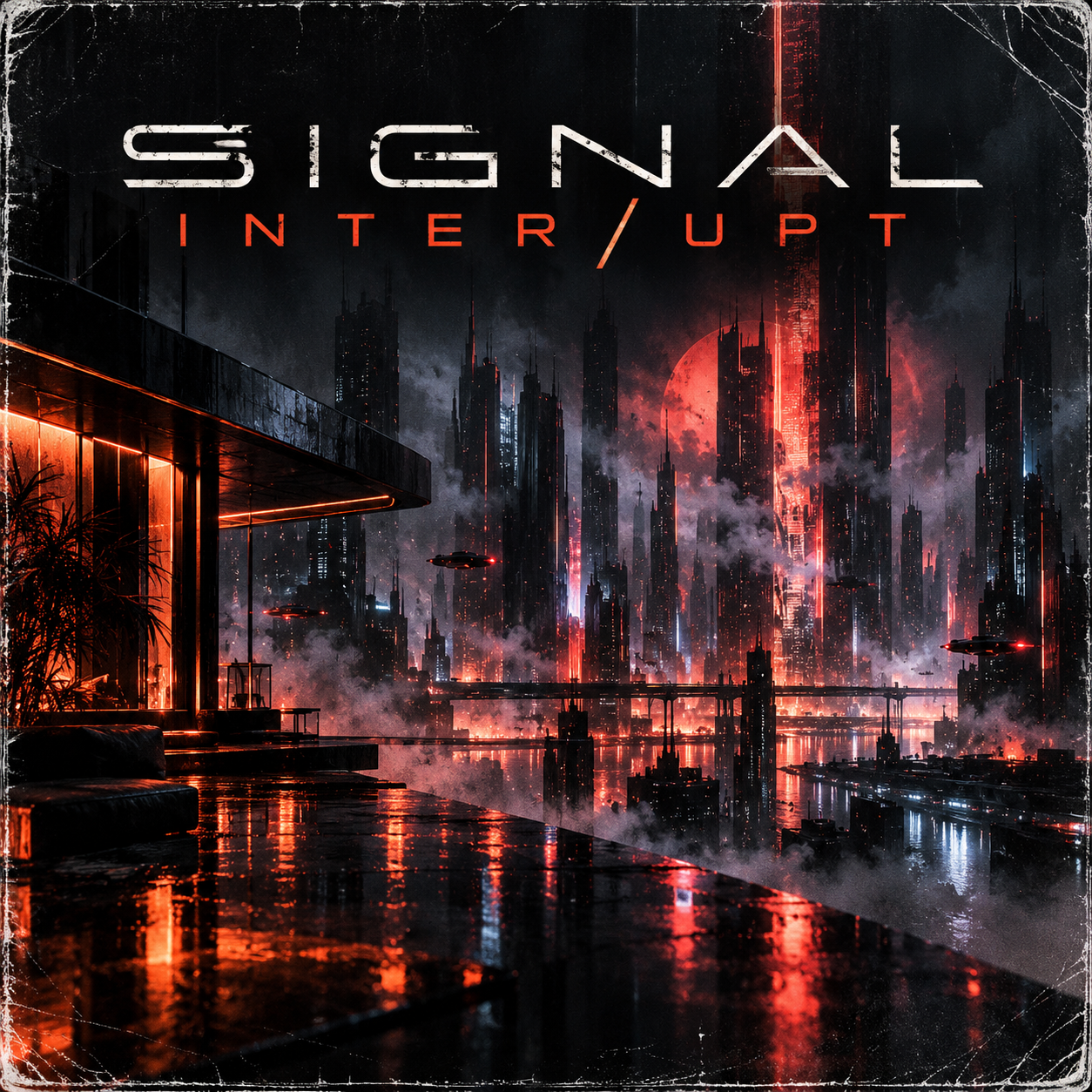

Those are broad descriptions, but they establish different compositional problems. An expansive environment can tolerate a sense of movement, density, and spectacle. An enclosed one may need restraint, persistence, and subtle changes that become uncomfortable precisely because they take so long to resolve. Neither identity can be reduced to choosing a different synthesizer preset or changing the album artwork. The music has to behave differently.
I didn’t want a soundtrack that announced every narrative development or translated the novel into a sequence of obvious musical cues. The novel leaves a great deal for the reader to infer, and the music should preserve that ambiguity. It can suggest luxury, intrusion, confinement, or instability without explaining what those things ultimately mean. In that sense, the soundtrack shares the novel’s perspective without functioning as an answer key.
Building an Instrument Vocabulary
Early in the production process, we developed a working catalog of sounds and techniques drawn from synthwave, techno, dark techno, Goa trance, psytrance, industrial music, electro-industrial, EBM, and adjacent electronic styles. The purpose was not to cram every available instrument into a track. It was to establish a vocabulary from which particular sounds could be selected for particular musical responsibilities.
A synthesizer isn’t merely a synthesizer when you are trying to describe a composition. A tightly sequenced acid line behaves differently from a slowly evolving pad. An aggressive, distorted bass can occupy the foreground as a rhythmic engine, while a low, nearly stationary drone can alter the emotional character of everything above it. Percussive metallic sounds can suggest machinery without becoming literal sound effects. A deliberately processed vocal can feel intimate, artificial, threatening, or detached depending on its texture and placement.
Instrument selection therefore became an act of arrangement before there was an arrangement. Each sound needed a reason to exist. Some supplied momentum; others supplied tension, atmosphere, contrast, or a recognizable identity that could survive changes elsewhere in the track. The most useful instructions were rarely requests for more sound. They identified which layer should carry the piece and which layers should support it without competing for attention.
That became especially important when an output interpreted an atmospheric description too literally. For one track, Tension, the target was an extravagant and unsettling environment associated with the privileged few of Aura-Veritas. The first results weren’t necessarily bad, but some of the instrumental decisions and vocal treatment were too obvious. The revision was about finding a more precise sonic identity, including a harsher vocal texture, not about making the track generically darker or more elaborate.
From Genre to Musical Behavior
Genre labels are useful shorthand, but they leave enormous freedom to the system interpreting them. Asking for Goa trance might produce the right general atmosphere without producing the insistent rhythmic and melodic behavior that makes a particular passage compelling. Asking for industrial music might deliver distorted percussion without establishing the relationship between its pulse, bass, and higher-frequency movement.
I began narrowing that freedom by describing what the parts should actually do. A persistent sixteenth-note sequence is a different instruction from a hypnotic melody. Describing how a bassline repeats, how the notes move against the pulse, or how the percussion reinforces and interrupts a phrase puts musical behavior into the specification instead of leaving it entirely to genre association. Tempo, subdivision, density, and note movement started doing work that adjectives couldn’t reliably do.
One particularly useful experiment came from examining the persistent melodic sequence in Astral Projection’s People Can Fly. The point was not to request a copy of the song, but to understand a specific mechanism: how repeated, tightly timed note movement can anchor a piece while other layers evolve around it. That gave me a more explicit language for communicating the timing and character of a sequence. From there, the goal was to apply the mechanism to music with its own narrative purpose and instrumental identity.
Percussion required similar attention. A kick drum could establish the floor of the composition, but what happened around it mattered just as much: the subdivision of the hats, the placement and weight of secondary hits, the relationship between a driving bass pattern and the spaces left by the drums. A pattern can contain the right instruments and still feel wrong because the events arrive with the wrong emphasis. In generative music, that difference can be easy to dismiss as variation. For this project, it was part of the composition.
This did not turn Suno into a note-perfect playback engine. A requested pattern was still interpreted by a generative model, and exact compliance varied. What changed was my ability to tell it what kind of variation was acceptable and to recognize when the result drifted away from the target. The closer the specifications came to describing musical relationships, the less I depended on the system guessing what a stylistic adjective meant.
Separating Sound from Time
Another substantial improvement was separating the sonic specification from the arrangement. The style instructions established the instrumental palette, texture, production characteristics, rhythmic character, and musical identity. A second map described how the track should develop over time: what should enter first, which elements should persist, when pressure should increase, where layers should be withdrawn, and how the composition should approach its ending.
This division mattered because choosing sounds and organizing them are different decisions. A song can contain every intended element and still fail because it introduces them in the wrong order, builds too slowly, spends too long preparing for its main idea, or mistakes an abrupt change for a satisfying transition. I didn’t want long introductions that spent several minutes circling the musical premise before finally delivering it. For many tracks, the core identity needed to arrive early, while the evolving arrangement supplied tension and development afterward.
I also supplied target runtimes. Occasionally the requested duration was unusual or extended, and sometimes a shorter arrangement suited the track better. Suno did not consistently honor those targets, even when other musical instructions were followed closely. That limitation is worth stating plainly. The process offered substantial practical influence over instrumentation, pacing, and musical structure, but it did not give me exact command of every timestamp or the total length of a generated file.
Still, separating the two specifications made the desired outcome much easier to communicate. Rather than asking the model to invent both the sound and the structure from a short mood description, I provided an instrumental concept and a plan for how that concept should unfold. The difference was audible.
Two Takes, One Survives
Suno returned two versions from the same instructions. In this workflow, those versions were frequently remarkably similar. They shared enough of the instrumentation, rhythmic identity, and broad structure that the question was often not which one had the better idea. It was which one had performed the existing idea more accurately.
I would keep the stronger track and discard the other. With small changes to the instructions where necessary, I would generate another pair, again retain the better result, and compare it against what had already survived. I also listened to competing versions side by side, one in each ear, to concentrate on the differences between their performances. A slight change in timing or phrasing could make one interpretation feel more faithful to the composition than the other, even when both were attractive in isolation.
This wasn’t an open-ended hunt for something surprising. The reference point stayed relatively stable. A new generation didn’t automatically replace an earlier one, and a more elaborate version didn’t win simply because it contained more detail. It had to justify its place by more closely matching the intention behind the track. The discarded versions could be perfectly listenable pieces of music. They were simply not the versions I wanted.
There is an important distinction between this kind of selection and treating iteration itself as evidence of artistry. Generating a hundred songs doesn’t make the hundredth more intentional than the first. In my case, the repetitions served a narrow purpose: identify a deviation, make a small correction if needed, and decide whether a new performance reduced the compromise. Once a result was right, there was no creative virtue in continuing to generate alternatives.
What the Speed Actually Meant
At one point we achieved a result that was almost exactly what I wanted on the first attempt. It would be easy to describe that as the system doing the creative work in seconds. But the apparent speed of the final generation leaves out what had already happened: the selection of reference characteristics, the construction of an instrument vocabulary, the definition of rhythmic and melodic behavior, and the separation of sonic direction from arrangement.
Much of the work traditionally performed through trial and error inside the recording process had been moved into the specification. We discussed the composition before asking the system to perform it. The better those decisions were articulated, the smaller the gap became between the requested outcome and the initial result. When two generations returned nearly the same track, that consistency wasn’t proof that every detail was under our control. It was evidence that enough of the decision space had been constrained to make selection meaningful.
The generative system still contributed. It supplied musical details, transitions, textures, and performances I had not individually written into a score. Sometimes those choices improved the piece; sometimes they moved it away from the intended sound. Acknowledging that contribution is necessary if the description of the process is to be accurate. Authorship does not require pretending I personally programmed every note, and creative direction does not require pretending the system made no decisions of its own.
The value of the process was that I could hear the distinction. I could recognize when an unexpected detail belonged, when a technically polished result failed the composition, and when the surviving take no longer required another correction. The system’s capacity to generate music made the process possible. The specifications and judgments made the results particular to this project.
Knowing When an Album Is Complete
An album is not finished because a folder contains enough audio files. Nor is it finished because every track is mixed to a comparable level of polish. For these two volumes, completion meant that the individual pieces had become recognizable parts of the same intended world while retaining their own musical identities. The albums had to work as collections, not merely as a set of successful prompts.
That required listening beyond the boundaries of a single song. A track’s density, emotional temperature, and duration affect the pieces around it. An aggressive arrangement can lose its effect if every other track is equally aggressive. A restrained passage can become more powerful when it follows something crowded and relentless. These relationships are difficult to solve by asking whether each generated output sounds good independently. They require an idea of what the whole album is meant to do.
Eventually, there was no reason to keep asking for more versions. Not because the software had exhausted its possibilities—it hadn’t—but because the surviving tracks were the ones I had been trying to hear. I had reached the point where further variation was more likely to introduce a new compromise than to resolve an existing one.
I don’t consider the machinery unimportant. Without generative tools, making two albums in this way would have required an entirely different set of resources, skills, collaborators, and production constraints. But the most interesting thing the machinery made possible wasn’t an endless supply of plausible songs. It was a working relationship between an imagined sound, a sufficiently precise description of that sound, and a repeated test of whether the result matched the intention.
The albums were completed by generating music, certainly. They were shaped by knowing what to reject.
The goal was never to find the best song the machine could make. It was to hear the song I had already decided belonged there.