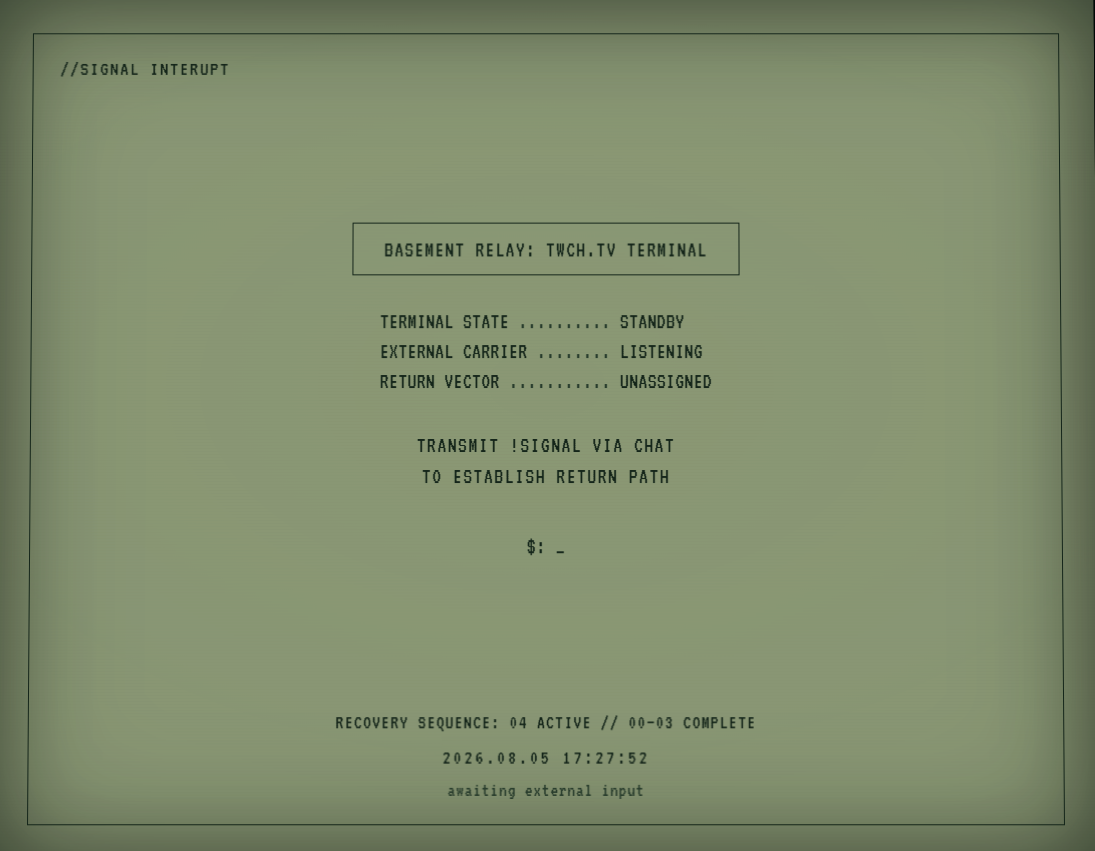
I think I’m making a new kind of livestream game. I’ve been calling it a CER Game, short for Chat Escape Room Game.
A CER Game is a community-driven event played in real time on a streaming platform. The audience must solve puzzles, interpret corrupted messages, discover valid commands, and unravel a narrative that builds toward a final resolution. Every completed level changes the state of the experience. Once the community reaches the end, the game is over.
That is the functional description, anyway.
The more interesting version is this: the stream is the room, Chat is trapped inside it together, and communication is how they escape.
There is no single player holding the controller. There may not even be a visible host. The game exists across the broadcast, the chat window, and the collective behavior of the people watching. Someone notices a detail. Someone else misreads it in a useful way. A third person turns that mistake into a theory. Then twenty people start testing variations until the system responds.
At that point, the puzzle is no longer merely on the screen. It is happening between people.
Where the idea came from
The first spark came from watching InGameAsylum on Twitch.
His channel revolves around playing games of, let us say, questionable independent quality. Rather than treating their broken mechanics, awkward performances, and strange little worlds as defects to endure, he places himself inside them. He calls these performances “immersions.” The game may be a mess, but that mess becomes a setting. The streamer becomes a character within it, and the audience participates in the fiction rather than merely watching somebody play.
When he rebuilt and rebranded the channel several years ago, he turned the reveal into an immersion of its own. Chat had to “unlock” the updated Asylum. Clues appeared through merchandise, channel details, and other fragments distributed around the community. In the tradition of an alternate reality game, viewers followed the trail until they reached the payoff: a transformed channel, improved production, and a deeper version of the world they had already chosen to inhabit.
That stayed with me.
The campaign did more than promote a redesign. It made the act of discovering the redesign into content. The audience did not receive an announcement. They earned the reveal together.
That opens a much larger door.
What if the mystery was not the runway leading to the stream’s content? What if, for a time, the mystery was the content?
What if the channel itself became an abandoned machine, a locked facility, a damaged relay, or some other place that could only be understood through interaction? What if Chat was not helping a streamer solve a game, but collectively operating the game through the same interface it already uses every day?
Twitch Chat is usually treated as commentary surrounding the primary experience. It reacts, jokes, backseats, repeats itself, argues, and occasionally notices something before the person on-screen does. A CER Game promotes all of that behavior into the primary control system.
The noise is not outside the game anymore. The noise is how the game thinks.
Building a large world inside a small screen
My first CER Game I’ve been building is intentionally minimal: a damaged terminal, a sickly CRT glow, an unstable connection, and the suggestion that something is operating far below the visible parts of Twitch.
It’s deliberately minimalistic. Atmosphere comes from layered details: fluorescent hum, distant mechanical sounds, corrupted text, delayed responses, interrupted boot sequences, failing network commands, and occasional evidence that something elsewhere in the system has noticed what Chat is doing. The terminal is not presented as a prop waiting politely for input. It feels old, unreliable, and slightly hostile. As the community makes progress, other parts of the fictional network resist.
This creates a useful imbalance between what the system appears to be and what it actually is.
On the surface, it looks dense. There are identifiers, timestamps, error codes, status lines, partial transmissions, malformed characters, and commands that may or may not do anything. It invites the audience to imagine a much larger machine behind the glass.
Underneath, the individual solutions can remain remarkably simple.
The answer is usually visible on-screen in some form. The difficulty is recognizing which information matters, understanding what it represents, and discovering the syntax the terminal will accept.
That distinction is important. I do not want puzzles that require viewers to possess obscure knowledge or leave the channel to perform hours of research. I want a system that provides the necessary information while making people doubt their interpretation of it.
The complexity is often perceived rather than mechanical.
Chat invents the macro system first. Viewers theorize about ciphers, coordinates, hexadecimal values, hidden networks, source code, lore, and conspiracies. They build a model large enough to explain everything they see. Eventually, that model becomes too cumbersome. Someone steps back, looks at the actual content in front of them, and notices the smaller relationship the puzzle has been presenting all along.
They retire the macro and move to the micro.
That moment feels good because the solution was not arbitrary. It was present, legible, and waiting for the right frame of reference. The environment caused the audience to overwhelm itself, but the resolution rewards observation rather than clairvoyance.
The puzzle develops a second location
During a recent test, something happened that clarified the entire format for me.
Chat formed a hive mind.
One person attempted a command. Others watched the terminal react and began repeating the same idea with small variations. A partially correct attempt produced a clue. Someone connected that clue to a previous line. Another viewer challenged the interpretation. The command mutated as it moved through the group until somebody landed on the correct form.
The puzzle had developed a second location.
One version existed on the terminal. The other existed in Chat.
The visible system held the evidence, but the community held the evolving model of what that evidence meant. Every message became a tiny public experiment. Failed commands were no longer private failures. They eliminated possibilities for everyone watching. Partial successes changed the direction of the group. Repetition, usually considered one of Chat’s least useful instincts, became distributed iteration.
This is where a CER Game separates itself from a conventional escape room or a single-player puzzle game.
In a physical escape room, a small group shares one space and can speak freely. In a traditional game, one player usually owns the inputs while everyone else advises. In a CER Game, dozens or hundreds of people may arrive with different levels of context, attention, confidence, and ability. They cannot coordinate cleanly, and that is precisely what gives the format its character.
The community becomes a messy parallel processor.
Some people are pattern matchers. Some document prior attempts. Some brute-force syntax. Some develop lore theories that are completely wrong but accidentally expose a useful connection. Some arrive late and ask the obvious question everyone else stopped asking twenty minutes ago. That person may solve the level.
The audience is not simply collaborating despite the chaos. It is collaborating through the chaos.
Designing for collective intelligence
This changes how the game has to respond.
A binary system that accepts only the exact answer and rejects everything else wastes the most interesting part of live play. The terminal needs to recognize proximity. A nearly correct command can produce a different error. A useful interpretation can trigger a clue. An invalid attempt can create a narrative response rather than a sterile failure message.
The system is effectively dungeon-mastering a crowd.
That does not mean quietly giving away the answer when people struggle. It means maintaining momentum, rewarding meaningful experimentation, and allowing the fiction to react without breaking character. If Chat pushes against the right boundary, the world should push back.
The timing matters too. Silence creates uncertainty. Delayed responses make the machine feel remote. Environmental events can imply that an attempted command affected something beyond the terminal. A network warning can transform progress into danger. The interface is doing narrative work even when no puzzle state changes.
The goal is not to make a hard puzzle and place it on Twitch. The goal is to create a responsive situation that a community can inhabit.
The real content is the attempt
Every puzzle game has an ending problem. Once the solution is known, much of its mystery disappears.
CER Games turn that limitation into part of the event.
The experience is temporary by design. The clues accumulate. The audience’s shared knowledge improves. Previously impossible levels become obvious in retrospect. The community moves toward a finale that permanently ends the game.
That creates stakes without requiring artificial competition. Chat is not racing against another team. It is racing toward the destruction of the thing it has gathered to experience.
The finale matters, but it is not the bulk of the content. The content is the attempt: the wrong theories, the accidental discoveries, the person who notices a corrupted character has changed, the flood of nearly identical commands, the sudden silence when the terminal responds in a way nobody expected.
The completed game leaves behind a story the community did not merely consume. It leaves behind a story about what the community did.
Livestreaming has spent years improving the relationship between performer and audience. CER Games explore a slightly different relationship: one between a community and a system that appears to be listening to all of them at once.
The streamer does not need to be the hero. The streamer may barely need to be visible.
The world is the performance. Chat is the protagonist.